 Timurid Chess
A 14th-century game, rebuilt with sources
Tamerlane's chess, played honestly.
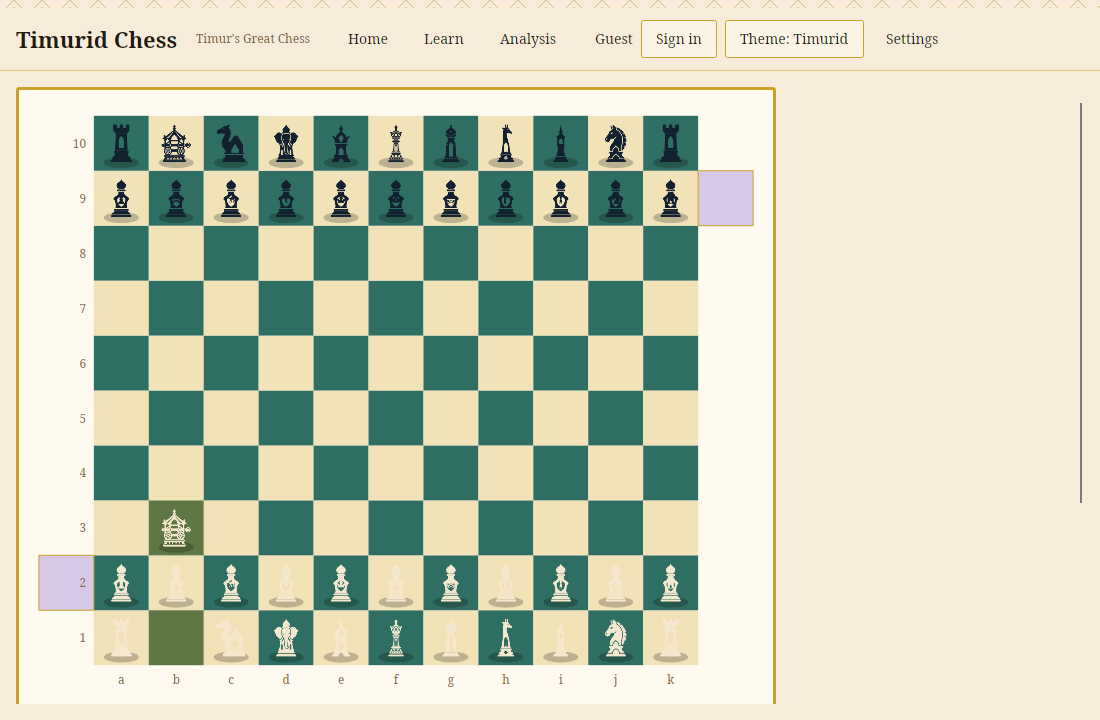
112 cells. Eleven distinct pawns, each tied to the piece it becomes. Citadels a bare king can run to. A royal hierarchy that outlives the Shah. Timurid Chess reconstructs the historical variant attributed to Timur (Tamerlane) — every rule that isn't settled by primary sources is flagged in the code, not silently guessed at.
Playing costs nothing to set up: jump in as a guest against the bot, or log in to play rated games against people. Native apps for desktop and Android are also available below.









Why it's different
A real reconstruction, not a reskin
Every uncertain rule is sourced and flagged in the engine — not invented for convenience.
Twelve piece types
The Giraffe's diagonal-then-orthogonal compound move, the leaping Camel and Elephant, the two-square Tali'a — pieces with no modern equivalent, implemented as genuine move generators, not modern pieces in costume.
Eleven pawn identities
Each pawn remembers which piece it promotes to — a Camel Pawn always becomes a Camel — including the Pawn of Kings (→ Prince) and the Pawn of Pawns' own three-stage promotion ladder.
Citadels
Two extra cells outside the 11×10 board. A lone king can run there and draw — reducing your opponent to bare king is not an automatic win.
Royal hierarchy
Princes and the Adventitious King mean checkmating the Shah doesn't always end the game. Stalemate isn't a draw either — the stalemating side wins.
A bot that actually searches
Alpha-beta with a transposition table, iterative deepening, and quiescence — five difficulty levels from Acemi to Gürkhani, playable offline or online.
Play anywhere
One shared C# rules engine drives a web client, a desktop app for Windows/macOS/Linux, and Android — local, vs the bot, or rated online play.
Two art directions
One engine, two moods
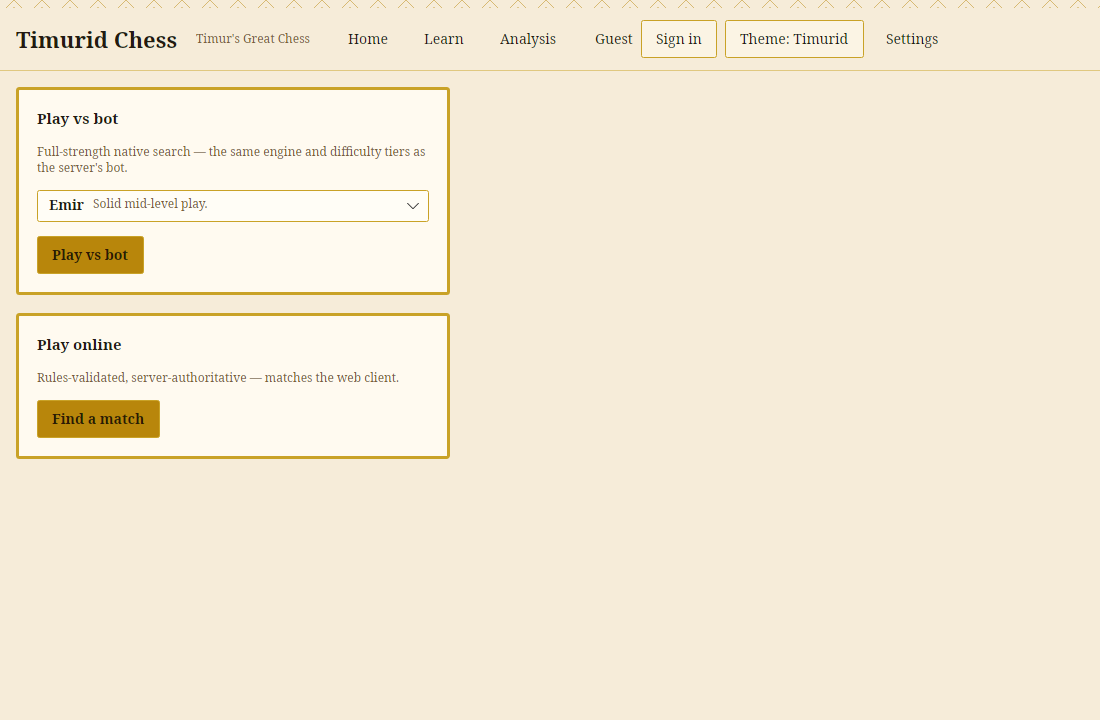
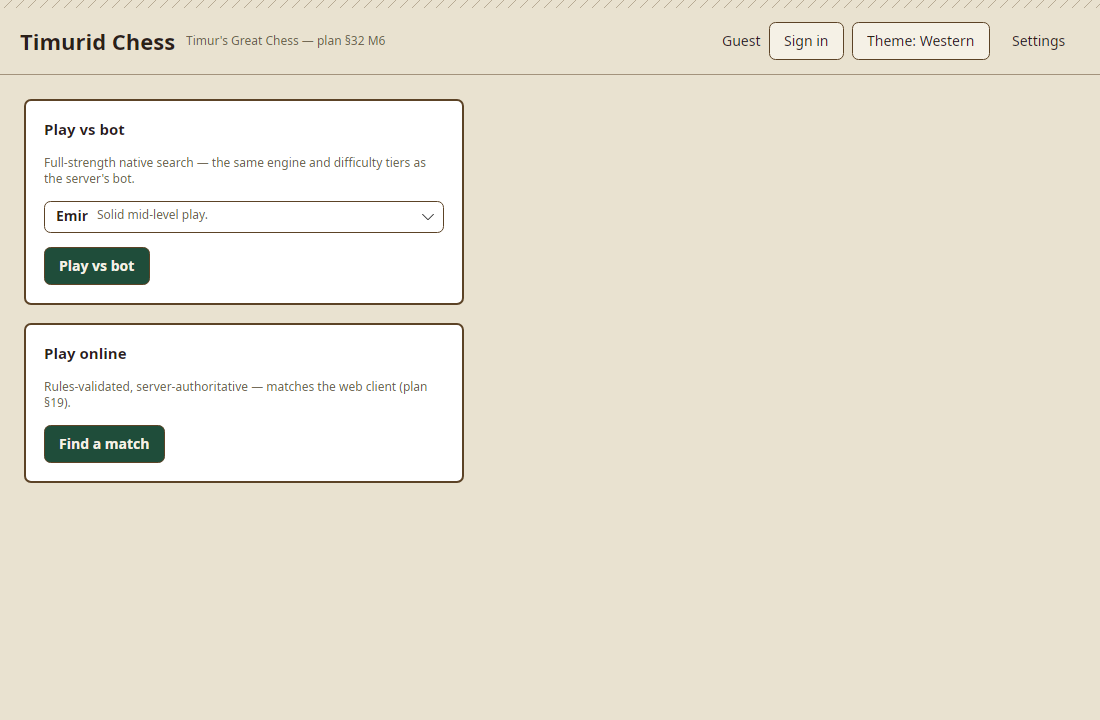
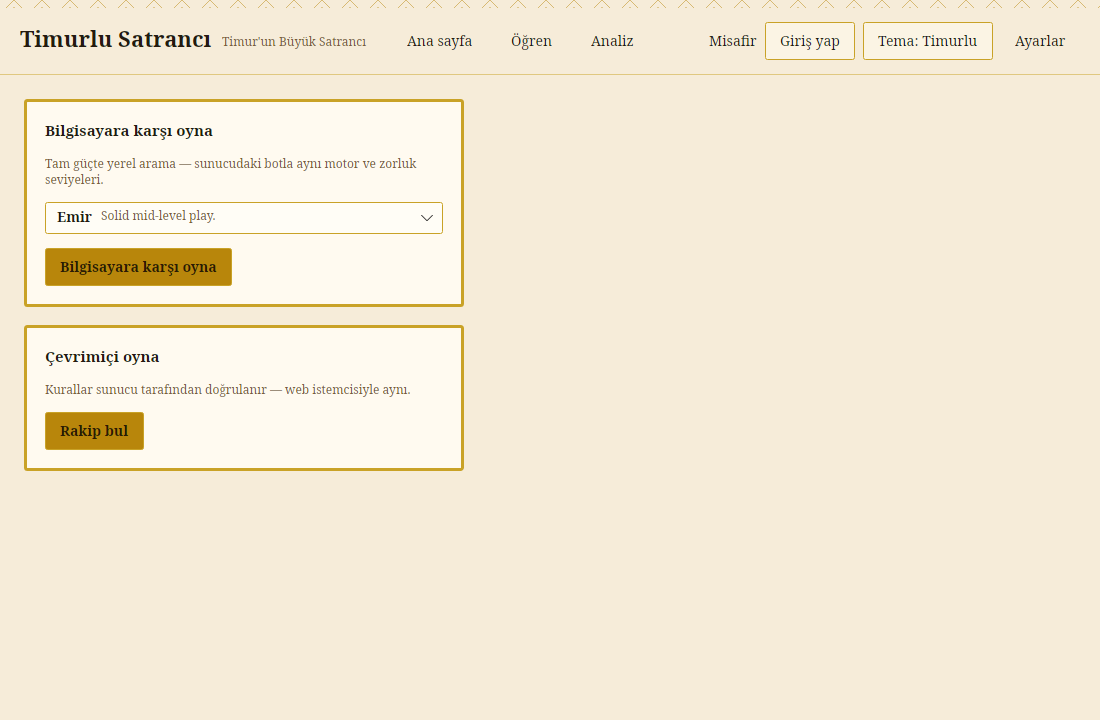
Switch between an illuminated-manuscript Timurid palette and a Western chess-club look — on the website, and in the app itself.
Play now, or install a native app
Play on your platform
The web client needs nothing installed — sign in or play as a guest. Prefer a native app? Download a signed build below.
Not modern chess
What's actually different
A short list for players coming from FIDE chess — see the in-app Learn screen for the full reference.
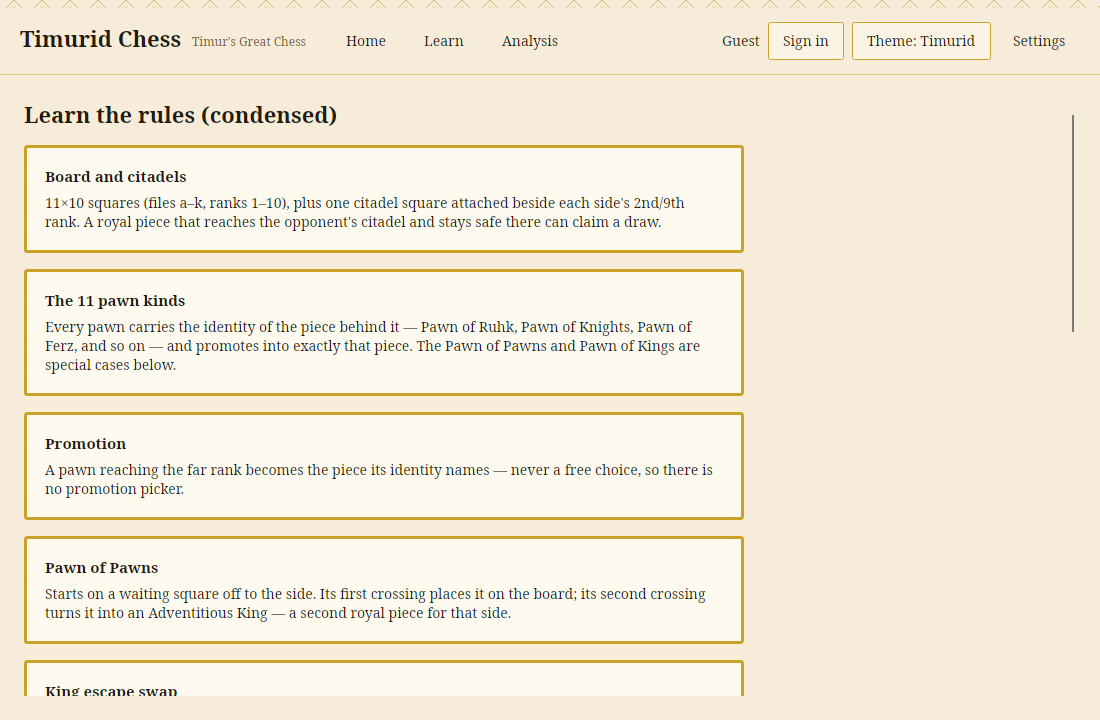
11×10 = 110 squares, plus two citadel cells attached to the 2nd and 9th ranks — 112 playable cells in total.
Stalemate is a win for the side that delivers it, not a draw.
Reducing the opponent to a lone king doesn't win automatically — that king can still reach a citadel and draw.
Neither exists in the historical core. The Shah instead has a one-time escape/swap right when in check, checkmate, or stalemate.
Each of the 11 pawns is tied to one piece and can only ever promote to that piece — a Camel Pawn becomes a Camel, never a Ruhk.
Promotes to a Prince, a second royal piece that also moves like the Shah — once it exists, checkmating the Shah doesn't always end the game.
A three-stage state machine: its final promotion can produce an Adventitious King, a third royal piece with its own citadel rights.
The historical core has neither rule — games are decided by checkmate, citadel draw, or stalemate.